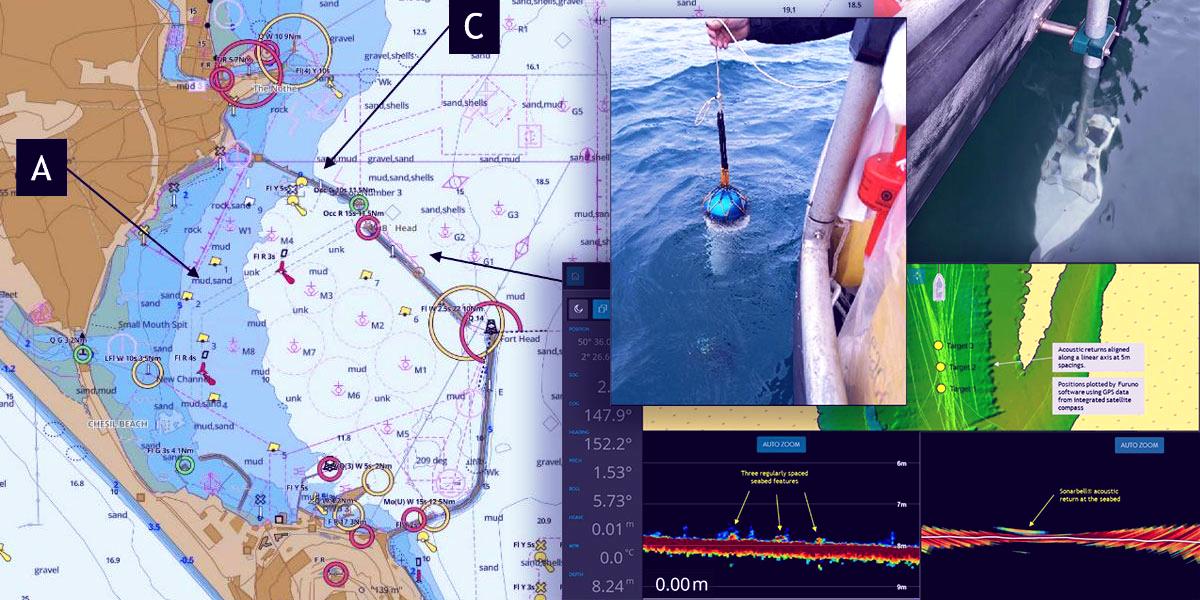
Clearwater Hydroacoustics have recently completed a successful series of tests demonstrating the viability of Sonarbell as an underwater marker for a range of marine applications. The work was conducted in various locations within the Portland Harbour / Weymouth Bay area enabling Sonarbell® to be assessed at different water depths, on different seabed types and topography.
Four different types of Sonarbell® were tested ranging in size from 100mm to 200mm in diameter and covering both plastic and metal materials. Testing was undertaken at frequencies ranging from 120kHz to 200kHz using a Furuno WASSP F3 Multi-Beam Echo Sounder (MBES) mounted to the Clearwater Hydroacoustics workboat. The sonar was integrated with a satellite compass which provided a variety of heading and position data, and an IMU for roll, pitch and heave compensation of the sonar image.

A single Sonarbell® on a 1.5 metre seabed tether was reliably and repeatedly detected by the sonar on multiple test runs. The characteristic double-echo response remains strong despite the addition of a flotation collar and can be easily discriminated from other acoustic reflections, from background noise, and from the seabed. Typical applications of this Sonarbell® arrangement include:
- Marking of seabed features, infrastructure or equipment;
- Marking of fishing gear (from the perspective of relocating it if lost);
- Marking of an underwater rendezvous point or docking point for an AUV;
- Denoting waymarkers in support of AUV navigation to enable correction of INS drift;
- Denoting an underwater boundary.
The trials have also shown how Sonarbell® can be deployed as a series of markers directly upon the seabed to create an underwater navigation route. A line of three Sonarbells® were reliably detected during multiple passes despite the additional complication of acoustic absorption by the seabed, and acoustic reflections from marine vegetation and man-made debris. Typical applications of this Sonarbell® arrangement include:
- Creating an underwater navigation route or series of waymarkers in support of AUV navigation to enable correction of INS drift;
- Denoting an underwater boundary.
The Sonarbell® signature was easily detectable in both the downscan and the forward-scan views from the Furuno WASSP F3 sonar. The distinctive double-echo could be discriminated from other acoustic reflections and contained the expected acoustic features. These features have already been used successfully for automated detection of Sonarbell® in a development version of Clearwater’s Auto-Detect® software and the dataset gathered during this latest trial now provides the basis for development of a real-time version.